Particle (Basic ㊦ 478)
A particle which marks a quotation, sound or the manner in which someone/something does something.
Equivalent: That; with the sound of; in the manner of
| (i) Quotation | と | |
| 「私は学生です。」と | “I am a student” | |
| 私は学生だと | That I am a student | |
| (ii) Phonomime | と | |
| バタバタと | With a clattering noise | |
| (iii) Phenomime | と | |
| ゆっくりと | Slowly | |
| (iv) Psychomime | と | |
| うきうきと | Cheerfully |
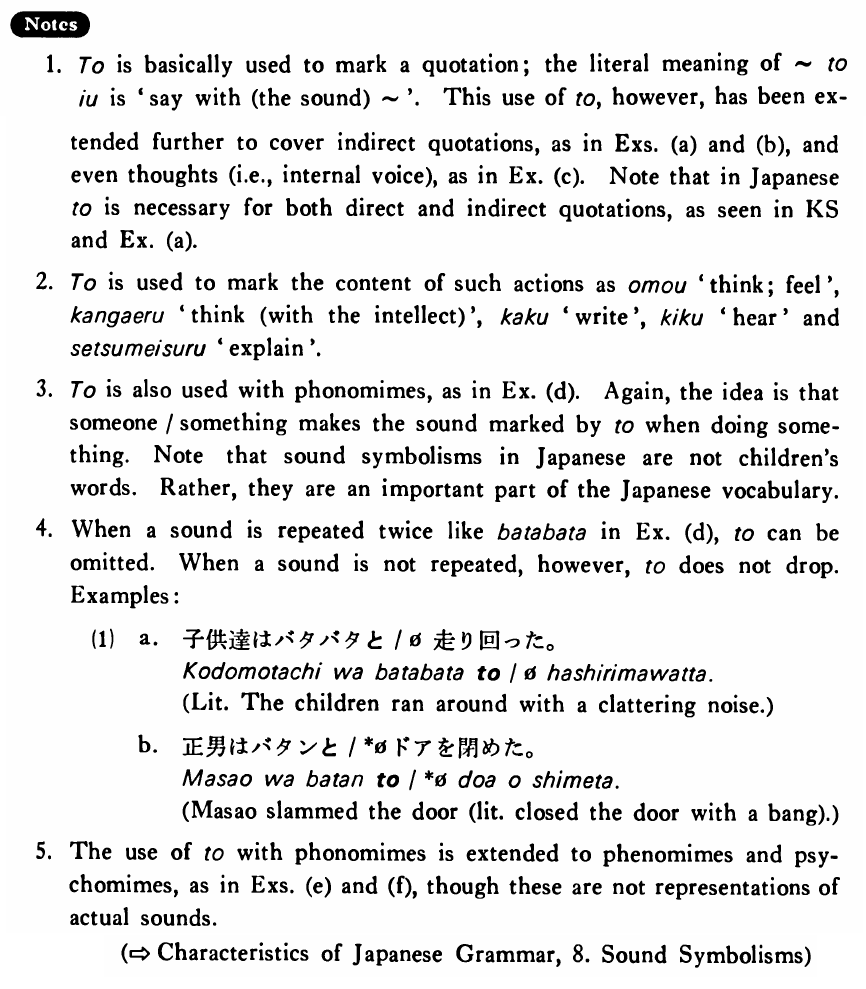
1. と is basically used to mark a quotation; the literal meaning of という is 'say with the (the sound) ~'. This use of と, however, has been extended further to cover indirect quotations, as in Examples (a) and (b), and even thoughts (i.e., internal voice), as in Example (c). Note that in Japanese と is necessary for both direct and indirect quotations, as seen in Key Sentence and Example (a).
2. と is used to mark the content of such actions as 思う 'think; feel', 考える 'think (with the intellect)', 書く 'write', 聞く 'hear', and 説明する 'explain'.
3. と is also used with phonomimes, as in Example (d). Again, the idea is that someone/something makes the sound marked by と when doing something. Note that sound symbolisms in Japanese are not children's words. Rather, they are an important part of the Japanese vocabulary.
4. When a sound is repeated twice like バタバタ in Example (d), と can be omitted. When a sound is not repeated, however, と does not drop. Examples:
5. The use of と with phonomimes is extended to phenomimes and psychomimes, as in Examples (e) and (f), though these are not representations of actual sounds.